
Marketplace Evidence
Why Active Listings Are Not the Same as Sold Prices
Active listings show what sellers hope to get. Sold prices show what buyers actually paid. Learn how to use better comps before buying thrift and estate-sale finds.
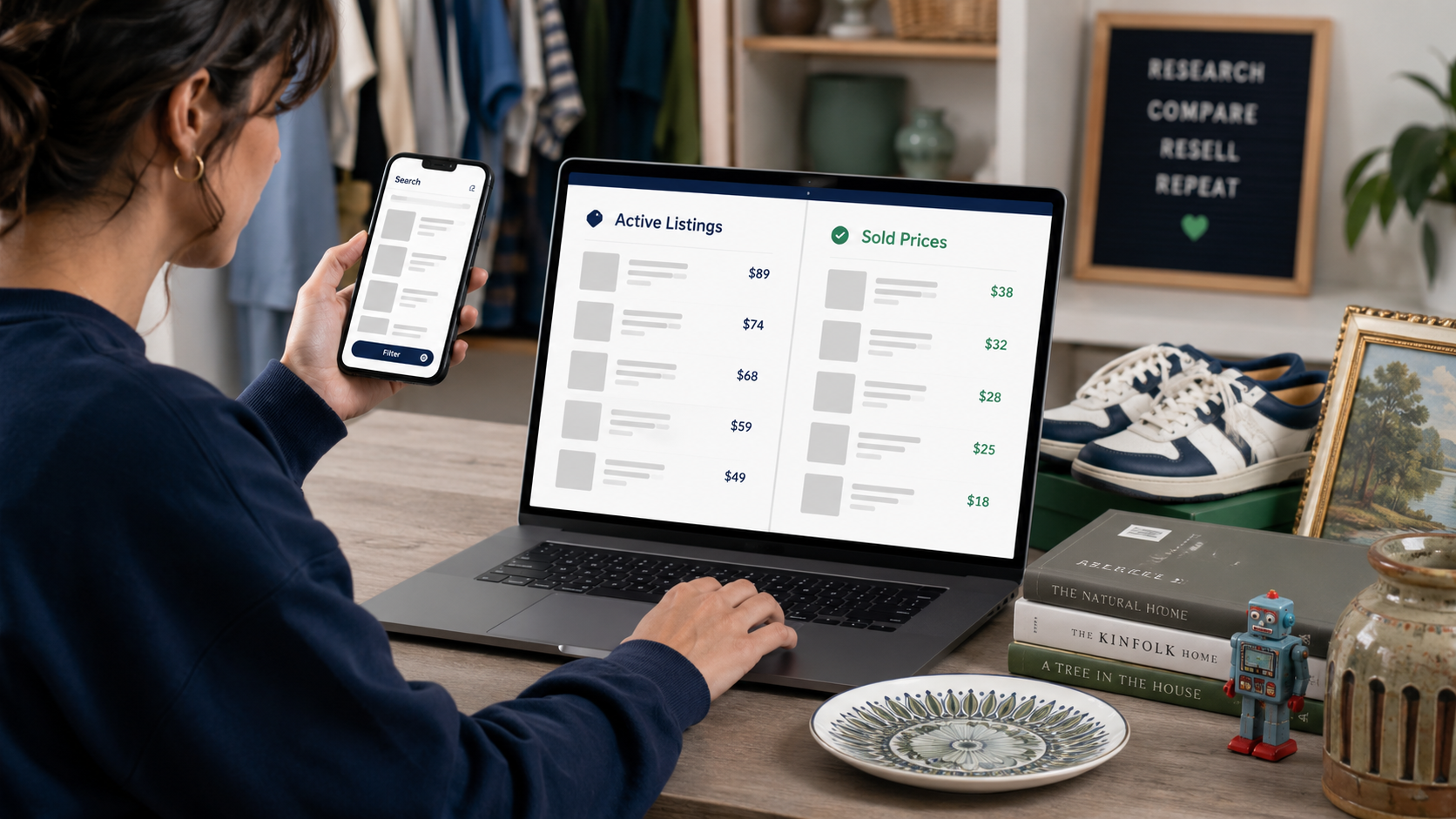
Active listings vs sold prices is one of the most important differences for resellers to understand before buying a thrift or estate-sale find.
An active listing can make almost anything look valuable. Search a thrift find online and you may see someone asking $80, $120, or even $250 for something sitting on the shelf for $6.99.
That does not mean the item is worth that much. It only means someone listed it at that price.
Active listings vs sold prices: asking is not selling
An active listing is simply an item that has not sold yet. The price may be realistic, too high, copied from another seller, based on hope, or waiting for a very specific buyer.
A mug listed for $99 is not automatically a $99 mug. A jacket listed for $180 is not automatically a $180 jacket. Sellers can ask anything they want.
Sold prices show what buyers actually paid
Sold comps are completed sales. They help answer the question that matters most when sourcing:
- Real buyer demand
- Realistic pricing
- How often similar items sell
- Whether condition changes value
- Whether the buy price leaves room for profit
One high listing can distort your decision
This is how bad buys happen: you see an item for $8, find an active listing for $90, assume there is profit, buy it, and later discover similar items usually sell for $18 to $25.
Look for multiple similar sold comps
A single sold comp is better than no evidence, but it can still be an outlier. A stronger decision comes from several relevant sold comps pointing in the same direction.
- Same brand
- Same model
- Same size
- Same pattern
- Same condition
- Same completeness
- Similar shipping
- Recent sale
If several similar items sold recently around the same range, that is useful evidence. If results are scattered, old, or not truly similar, the decision is weaker.
Even sold prices need context
Sold data is stronger than active listings, but it still needs judgment. Some sold listings may involve accepted offers, bundles, free shipping, local pickup, incomplete data, or unusual buyer behavior.
Compare condition before trusting a comp
A sold comp is only useful if the item is close enough to what you are holding.
- Is the condition similar?
- Are the box, pieces, or accessories included?
- Is one item new while yours is used?
- Is one item tested while yours is untested?
- Is one item cleaned and photographed better?
A clean, complete, tested item may sell well. A damaged or incomplete version may not.
Check whether shipping changes the math
Two sold prices can look similar but produce very different profit. An item sold for $45 with buyer-paid shipping is not the same as an item sold for $45 with free shipping.
- Is the item heavy, fragile, oversized, or awkward?
- Will it need special packing materials?
- Will the buyer see shipping as too expensive?
- Does the sold comp include free shipping?
Comp-check framework
Use active listings for context, not proof
Several recent sold comps match closely, condition is manageable, and profit still works after fees and shipping.
Some sold comps exist, but pricing is inconsistent, condition matters, or the item needs more research.
Mostly active listings, few sold comps, unclear identity, poor condition, or thin profit.
Final takeaway
Active listings show what sellers hope to get. Sold prices show what buyers actually paid.
- Do not treat high active listings as proof of value.
- Look for multiple recent sold comps.
- Compare condition, completeness, and shipping carefully.
- Make the decision based on realistic profit, not the highest number you can find.
A good flip has clear identity, relevant sold comps, manageable condition, realistic shipping, and enough profit to justify the work.
Common questions about active listings and sold comps
What is the difference between active listings and sold comps?
Active listings show what sellers are asking for an item. Sold comps show what buyers actually paid for similar items. Active listings can help with research, but sold comps are usually stronger resale evidence because they reflect completed buyer behavior.
Are active listings useful for resellers?
Yes, but they should be used as context, not proof of value. Active listings can help with keywords, category clues, competing listings, and seller positioning. Before buying, resellers should still check similar sold items, condition, shipping risk, fees, and realistic profit.
Can sold comps predict exactly what my item will sell for?
No. Sold comps are evidence, not a guarantee. A good comp still needs to match the item closely by brand, model, condition, completeness, timing, marketplace, and shipping setup.
How many sold comps should I check before buying?
Several similar sold comps are better than one high result. One comp can be a clue, but a pattern of recent, similar sales gives a stronger signal about demand and realistic pricing.
Use evidence before you buy
Make better sourcing decisions with FlypSense.
FlypSense helps resellers make better buy, maybe, or skip decisions before they spend money. Scan thrift and estate-sale finds, review resale signals, check marketplace evidence, and spot risk before the item ends up in your cart.
Request Beta AccessKeep learning
Explore more evidence-based resale education in the FlypSense Resale Guides, or return to the FlypSense homepage.