
Bad Buy Prevention
Buy, Maybe, or Skip: A Reseller’s Sourcing Framework
Use a buy, maybe, or skip resale framework to make better thrift, estate sale, and marketplace sourcing decisions before you spend money.
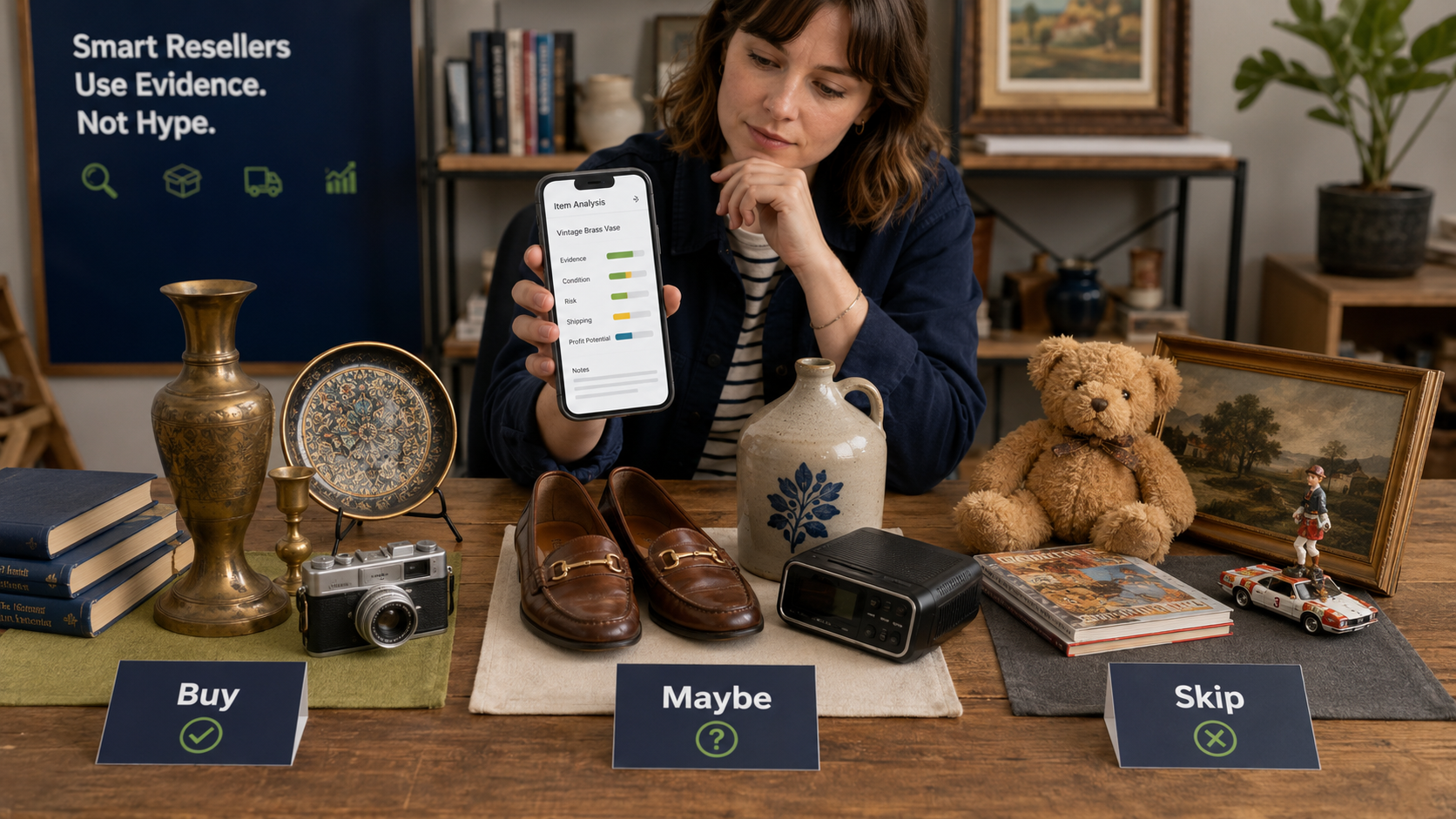
A buy maybe skip resale framework helps resellers slow down, check the evidence, and avoid turning every interesting thrift or estate-sale find into a purchase.
When you are sourcing, the item in your hand can feel more exciting than the facts on the screen. A strange vase, clean pair of shoes, sealed game, vintage jacket, or brass decor piece can look like profit before you have confirmed the basics.
The point of a framework is simple: decide what evidence would make the item a buy, what uncertainty makes it a maybe, and what risk makes it a skip.
Quick framework
Use buy, maybe, or skip before you put it in the cart
The item has clear identity, relevant sold comps, manageable condition, realistic shipping, and enough profit to justify the work.
The item has potential, but one or more important signals still need confirmation before you spend money.
The evidence is weak, the item is too risky, or the likely profit does not justify the time, space, shipping, and return risk.
Start with identity before price
Before you check value, make sure you know what you are actually researching. Weak identity creates weak comps.
- Look for a brand, maker mark, label, model number, style code, barcode, ISBN, pattern, or set number.
- Check the bottom, back, tag, box, lid, label, and inside seams when relevant.
- Do not rely only on visual similarity if the category depends on exact identifiers.
- Treat unclear identity as a maybe unless the buy price is low enough to absorb the risk.
Check sold evidence, not the highest active listing
A high active listing can make almost anything look valuable. Sold comps give you better evidence of what buyers actually paid.
Look for several sold results that match the item as closely as possible.
- Same brand
- Same size
- Same pattern
- Same condition
- Same quantity
- Same completeness
- Recent sale
- Similar shipping
Let condition change the decision
Condition is one of the fastest ways a buy becomes a maybe or a skip.
- Check for chips, cracks, stains, holes, odor, scratches, corrosion, missing pieces, and repairs.
- Ask whether the flaw is normal for the category or value-damaging.
- Compare your item to sold comps with similar condition.
- Reduce your expected value if the comps are cleaner, complete, boxed, or tested.
Check shipping before you trust the margin
Some items look profitable until you think about the box, weight, breakage risk, and buyer shipping cost.
This matters especially for lamps, dishes, framed art, cast iron, glassware, large toys, board games, and bulky homegoods.
- Is it heavy?
- Is it fragile?
- Is it oversized?
- Will it need double boxing?
- Will shipping make the listing unattractive?
- Do you have space to store it safely?
Decide your maximum buy price
A sourcing decision should be based on likely profit, not the sale price alone.
Before buying, estimate the real costs:
Use maybe as a pause, not a purchase excuse
Maybe is the most useful decision when you are not sure. It means the item has potential, but the evidence is not strong enough yet.
A maybe should trigger a next step:
- Find a better identifier.
- Check more sold comps.
- Inspect condition more closely.
- Confirm completeness.
- Lower the maximum buy price.
- Leave it behind if the uncertainty stays high.
If you cannot turn maybe into a stronger decision quickly, it is usually safer to pass.
Know when skip is the winning move
Passing on a questionable item is not a missed opportunity. It is how you protect cash, storage space, and attention for better buys.
- Skip when identity is unclear and comps are weak.
- Skip when condition problems are value-changing.
- Skip when shipping risk is too high.
- Skip when the market looks flooded.
- Skip when the profit is too thin for the work.
- Skip when the item only looks good because of one unrealistic active listing.
Final takeaway
A buy maybe skip resale framework helps you make sourcing decisions with evidence instead of excitement.
- Buy when the identity, sold comps, condition, shipping, and profit all support the decision.
- Maybe when the item has potential but still needs confirmation.
- Skip when the risk, uncertainty, or workload is too high for the likely reward.
The best resellers are not the ones who buy every interesting item. They are the ones who know which finds deserve money, time, and space.
Use evidence before you buy
Make better buy, maybe, or skip decisions with FlypSense.
FlypSense helps resellers scan thrift and estate-sale finds, review resale signals, check marketplace evidence, and spot risk before the item ends up in your cart.
Request Beta AccessKeep learning
Explore more evidence-based resale education in the FlypSense Resale Guides, or return to the FlypSense homepage.