
Sourcing Tools
Google Lens for Resellers: Why Identification Is Not Enough
Google Lens can help identify a thrift find, but resellers still need sold comps, condition checks, shipping risk, and profit math before buying.
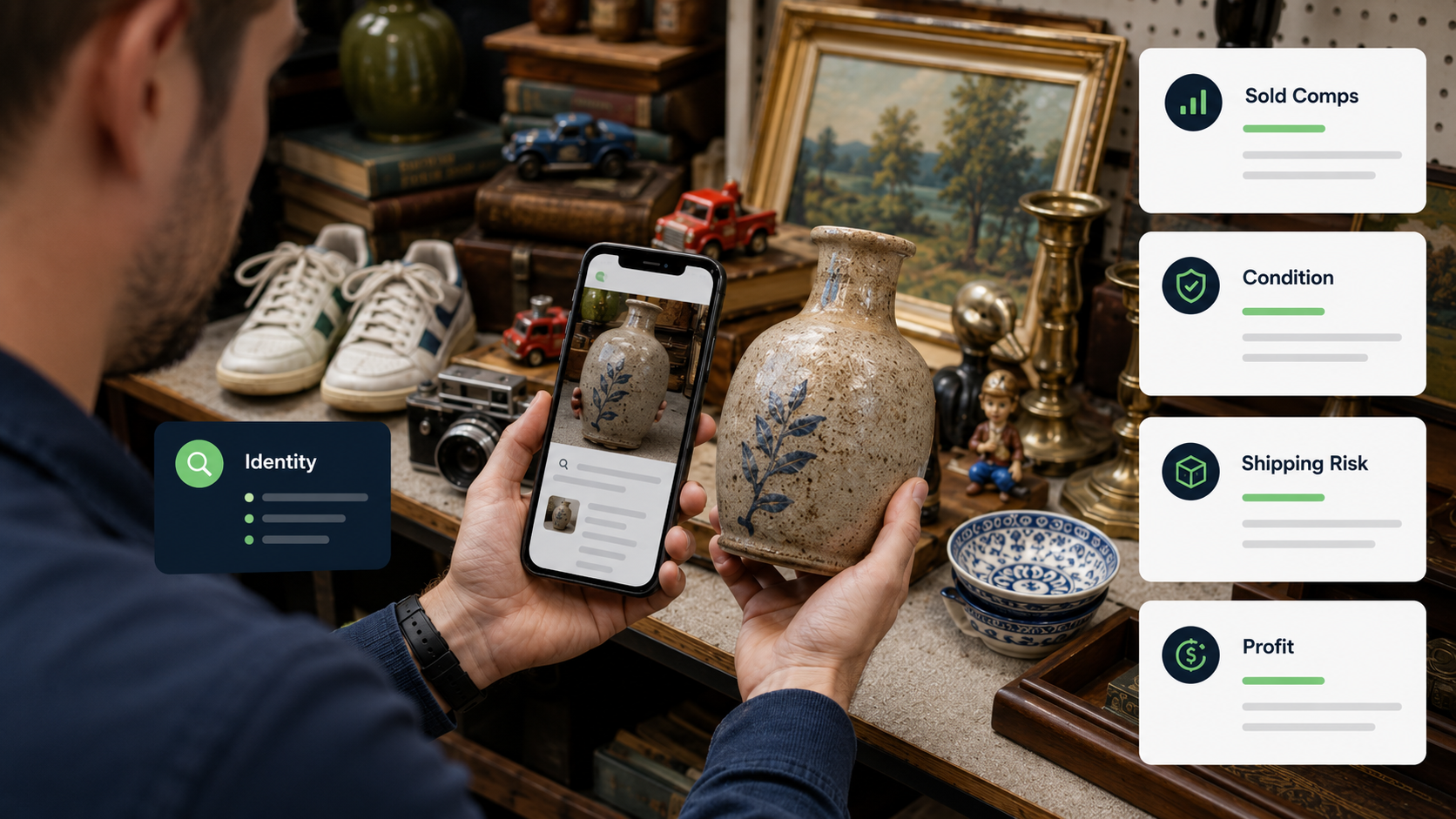
Google Lens for resellers can be useful for identifying a thrift find, but identification is not the same thing as a resale decision.
Visual search can help you figure out what an item might be. That is valuable when you are staring at an unfamiliar vase, jacket, toy, shoe, book, or piece of vintage home decor.
But reselling has a second question that visual search does not always answer well: should you actually buy it?
Quick answer
Visual search can start the research. It should not finish the decision.
Use visual search to get possible names, similar-looking items, keywords, and research direction.
Do not treat a visual match as proof of value, demand, authenticity, or profit.
Do not buy only because a similar image shows a high active listing or an attractive asking price.
Visual matches can be close but not correct
Two items can look similar and still have very different resale value.
A visual search result may point you toward the right category, but it can miss the exact pattern, edition, material, maker, size, year, model, or condition difference that actually matters.
- A reproduction can look like an older collectible.
- A similar pattern can sell for far less than the real one.
- A different size, edition, or material can change the market.
- A visually similar active listing may not be a true comp.
Identification does not prove demand
Knowing what something is does not mean buyers want it.
A visual search result may help identify a brand or item type, but resellers still need to know whether similar items actually sell.
Before buying, look for real marketplace evidence:
- Recent sold comps
- Similar condition
- Similar size
- Same model
- Same pattern
- Complete item
- Buyer-paid price
- Realistic shipping
Active listings can create false confidence
Visual search often leads to active listings. That can be helpful, but active listings are asking prices, not proof of market value.
Someone can list an item for $99 even if buyers usually pay $18. The high number looks exciting in the aisle, but it may not represent reality.
- Check sold results before trusting a price.
- Compare several similar completed sales.
- Watch for outliers and unrealistic asking prices.
- Do not anchor your buy decision to the highest number on the screen.
Condition still has to be checked by you
Visual search does not know what you are holding smells like, whether the zipper works, whether the glass is chipped, or whether a game is missing pieces.
Condition can turn a good-looking match into a pass.
- Look for chips, cracks, repairs, stains, odors, corrosion, scratches, missing parts, and peeling labels.
- Check whether the item is complete, tested, boxed, or sealed when that matters.
- Compare your item to sold comps with similar condition, not perfect examples.
- Reduce your expected price when your item has more risk than the comp.
Shipping and handling can erase the win
A visual search result may show a promising item, but it will not always make the packing and shipping decision for you.
This matters for fragile, heavy, oversized, or awkward finds.
Profit math matters more than the match
The goal is not to identify more items. The goal is to buy better ones.
Before you decide, estimate the real margin:
- What is the buy price?
- What do similar items actually sell for?
- What will fees, shipping, and packing cost?
- How much work will cleaning, photos, listing, and shipping require?
- Is the expected profit worth the time and risk?
If the answer is not clear, the item may be a maybe or a skip, even if visual search identified it correctly.
Use a better resale workflow
Visual search can be part of a good sourcing workflow. It just should not be the whole workflow.
A stronger process looks like this:
- Use visual search to get possible identity clues.
- Confirm the item with labels, marks, model numbers, tags, patterns, or other identifiers.
- Check sold comps instead of relying on active listings.
- Inspect condition and completeness.
- Estimate shipping, fees, and time.
- Decide buy, maybe, or skip based on evidence.
Final takeaway
Google Lens for resellers can be useful, but it is not enough by itself.
Visual search can help answer, “What might this be?”
Resale judgment has to answer, “Is this worth buying?”
- Use visual search for clues.
- Use sold comps for market evidence.
- Use condition checks to protect the price.
- Use shipping and profit math before spending money.
The best sourcing decisions come from combining identity with evidence, not from trusting one visual match.
Common questions about Google Lens and resale research
Is Google Lens enough for resellers?
Google Lens can help identify a thrift or estate-sale find, but it is not enough by itself. Resellers still need to check sold comps, condition, shipping risk, fees, effort, and realistic demand before deciding whether to buy.
What does visual search miss when reselling?
Visual search can miss condition, authenticity clues, exact model differences, size, material, completeness, shipping risk, and whether similar items actually sell. A close visual match is a starting point, not a complete resale decision.
Why can active listings from visual search be risky?
Visual search may lead to high active listings, but active listings are asking prices. They do not prove that buyers are paying those prices. Resellers should look for completed sold results before trusting a price signal.
Use evidence before you buy
FlypSense is built for resale decisions, not just item identification.
Scan thrift and estate-sale finds, review resale signals, check marketplace evidence, and spot risk before the item ends up in your cart.
Request Beta AccessKeep learning
Explore more evidence-based resale education in the FlypSense Resale Guides, or return to the FlypSense homepage.